Showing posts with label Black Books. Show all posts

Sunday, December 11, 2016

"YEAR OF YES" AS A FUNNY FEMINIST MANIFESTO?


I'm just kidding. Shonda Rhimes' boo is written in too silly a style to be called a "manifesto." Or is it? I do feel like she set an agenda for women in some way.


To be honest, the silly way she was writing it was kinda getting on my nerves at first, which is funny because....something about the way Rhimes is silly sounds very, very much like me. (
I don't think I want to think about that too hard)

I'd say this book is part biography and part self-help book with a definitively feminist slant. It's not preachy though. She talks about her deep longings and feeling like an outsider. Taking her life area by area, Shonda tells you what she was doing, what she was afraid of at the time, and how she was not responding appropriately. She tells you how she was trying to hide. 


Then she follows up by telling you how she said to herself "Why are you doing this? This is dumb" and where she went from there.


I can't actually remember if she ever mentioned the f-word (feminism) directly. But a lot of the personal growth she talked about was about pushing herself through things women commonly struggle with such as women valuing themselves. She also spends time on how women shouldn't be afraid to call attention to themselves when they want to be successful or when they already are successful.*
She really broke fear of success all the way down. For me reading this book right now wound up being a happy coincidence. For whatever reason, I'd been thinking about how women are praised for "humility" a lot more than men are quite a bit this year.  I believe this has had a lot of negative impact on me. But that's a whole other subject.

As much as I'd already thought about how women's work in the home is devalued, Shonda's words on the subject tweaked my thinking even more.

When she started talking about how mothers are regarded all year long and what they are actually praised for on Mother's day, I kind of reared back thinking, "Damn, she's right."

On mother's day, women are being praised for working like dogs while being almost invisible 364 days a year."

She made me think that there is an entire new industry to be created around self-esteem appropriate mother's day cards that are currently missing from the marketplace.  

She also confirmed what I've been thinking for a while now. There's a reason so many women are not rushing to get married these days -- and it doesn't have a thing to do with loving the idea of work or loving their career more than they love the idea of raising a family. Most women want to do both.  


I have an idea of what marriage should be that doesn't look anything like what most of my friends went through--- and that was before they got divorced.

It has always amazed me how few women think of how solid their friendship is before they get married. I mean, so many women put up with a level of self-centeredness from their men that they would never, ever put up with in a friend. That's because many women suffer from sexist thinking, right? They think "That's just the way men are." And then women file 80 to 90% of the divorces.

Louise of the movie THELMA AND LOUISE  probably said it best. "You get what you settle for."

There was a book out a decade or so ago called, WHY MEN LOVE BITCHES I read a few chapters over time at a library or something (pssst -- multiple visits to a bookstore) broken up with yet another control freak.  I figured I must be doing something wrong if I was attracting men that got on my nerves so quickly. So I decided to skim it and wound up reading a few chapters.

The behavior the woman described in the book would indeed get her called a "bitch" in a number of circles. But all she was describing was basic self-worth.  


For example she told a story of an elderly aunt calling when she was on her way out with her boyfriend, an aunt she doesn't hear from often. Apparently, he started behaving like an jerk about 2 minutes into the conversation. I can't remember her exact response. But it went something like, "I'm sorry. I didn't realize you had limited time to do" X. "We'll get together another time....Bye."


The boyfriend was shocked that she didn't go out with him that night, shocked that she didn't hang up on her Aunt as if she was not nearly as important as he was. But the next few time he spoke to her? He did it with respect, according to the author of the book.  


I'd seen multple scenarios, in real life, go a totally different way from what the author wrote. Mostly what I saw friends do was try to anxiously appease everybody at the same time while almost frightened(?) of his response  -- not afraid of physical abuse but afraid of his displeasure.  
After watching so many women behave in this way during the slightest conflict, it's not that surprising that its the woman that files for divorce most of the time. Trying to fix somebody who doesn't respect for years on end has to be exhausting. A lot of women have told me about how they didn't feel loved when they decided to get divorced. But the scenarios they described as "unloving" were actually about lack of respect. 
Rhimes also talked about changing her own behavior away from what most of us were taught was "good behavior" for a women in her book. I wouldn't say anything in the book is new or ground breaking. But it's like Maya Angelou said, "People don't remember what you said. People remember how you made them feel." And it made me feel good to know that a woman as successful and powerful as Shonda Rhimes was just as squirrely, slippin and sliding on thin ice, scared of the wrong things WHILE she was becoming successful. 

That's the thing I liked most about Shonda's book.  She didn't try to tell you that she had all her self-worth issues worked out and that she was handling everything before she was successful. Hard work and quasi-obsession in doing what she loved brought her success. It was not perfection in any way shape of form that brought her success.

Tons and tons of women need to read a book like this and feel good about where they are now and what's possible in the future no matter how messy life looks in the here and now.   


Tuesday, November 17, 2015

WHEN AND WHERE BLACK WOMEN ENTER

BOOK TITLE:


When and Where I Enter:
The Impact of Black Women on Race and Sex in America


This 21 year old book is awesome. It was copyrighted in 1984, during the Reagan administration, a dozen or so years after the end of the Civil Rights Movement.


I'd already read Giddings'  "Sword Among Lions," her biography on Ida B Wells.  That book made me curious about the Black Women's Club Movement that began to develop a few decades after slavery among middle-class, black women.  I was amazed to figure out that black women and black men of that time (late 1800s to 1920s) were so much closer to feminist equality in their approach to life than we are now.

I've been thinking that slavery and  the poverty immediately following slavery forced black men and black women to work as a team toward advancement without hard divisions in gender roles.

There was gender bias in the black community, don't get me wrong.

However, black women of the time had fresh memory of slavery in their own heads from experience or from the oral history of their mothers to keep them from accepting or expecting their men to treat them like second class citizens - unlike white women.  Black women had to work to support the family just like the black men did.

Maybe black men had a fresher memory of domination as well for a while, too fresh to reproduce it in the direction of black women---for a short time anyway.

Black women of the late 1800s and 1920s created their own clubs and political organizations and led the anti-lynching fight. Ida B Wells did some of the first sociological studies in this country on lynching. More importantly, she knew how to affect southern white money. She traveled outside this country to where the primary cotton buyers were, England, and got anti-lynching resolutions passed there. As a result,  whites in Memphis --a location that was a primary cotton producer of the world-- were shamed into stopping lynching cold. There was no lynching at all for 20 years straight after Ida B Wells trips. Lynching was reduced across the country from all time highs.

The NAACP ( Ida B Wells one of the founders) copied her methods and used the anti-lynching issue to establish itself.

But this book gave me so much more of an overview of black history from a black female perspective that was nothing short of amazing to read. The book covers the period from slavery through The Civil Rights movement.


Blacks are divided by class just like everybody else. But it was interesting to read that people had to work to overcome that. Music was one of the things used to bring different classes of blacks together. It was a calculated and deliberate thing using music to unite black people at protests, not just a black people love music thing like I was always taught (--put this in the stereotypes black people like to believe along side the big dick one)

How sexism and poverty come together to create black women's achievement in school was made clear too. It was so obvious I couldn't believe I hadn't just come to it myself.

Black men used to quit school to support the family by getting blue collar jobs. Black women would couldn't do the same thing. At domestic jobs they were paid little or nothing, and raped besides. In order for black women to bring more money into the home, they had to get more education and leave domestics jobs.

In other words, blue collar black women (domestics) made a lot less money than black men in blue collar jobs. In white collar "women's jobs," teachers and social workers, black women better off than un-credentialed female domestics, yet still didn't make as much money as un-credentialed black men. At one point during the 60s, despite black women having more education, black women were still, on average, making 75 cents for every black male dollar.

And THIS, according to The Moynihan Report was part of black women emasculating black men and destroying the black family. Earning a wage that was critical to the family's survival and earning a wage so close to her husbands (remember it's 1965) was undermining of his masculinity.That's just one of many stereotypes about black women created by men of all colors between during the mid 20th century.


According to the author (and others)  The Moynihan Report was reviewed by many black male civil rights leaders, including Martin Luther King, prior to publication. So, Moynihan must have been quite shocked at the nasty reaction he got from the black community.

I'm not sure if The Moynihan Report was the first attempt to shift the effects of white racism onto black culture via the black woman, complete with black cosigning, but it surely wasn't the last.

Regarding colorism, the book was very light on this point. I know THIS book wasn't about THAT. But the book would have been a little more perfect if the author had been frank or detailed about linking middle class blackness and being light-colored, and how that came right out of house-slave/field hand. The color divide continued/continues from slavery through the 1960s to now --only most black people don't realize that historically, this is also a class divide.

a highly rated supplemental book that addresses race, color and class


Also, not examining the class/color divide could leave some thinking that whiteness adds IQ to the black race, just as white racists who keep saying "Obama is part white ya know" seem to believe. White racists will believe anything, I know. But a hole in our history can leave some blacks believing this as well.  We cannot afford to leave gaps where more internalized racism can get in.


Since Giddings was so brave in other sections of the book and covered so much of black history in general in order to give context to black women's history, it just seems odd to have skipped over the colorism link to class as it didn't exist.


Paula Giddings also explained much about shifting gender roles for women, of course, but also for men.

For some reason it never really occurred to me that men had a shift in ideals in regards to what "a real man" looks like, a shift that was independent of wanting equality.

There was a shift from men wanting to be
establishment/corporate/always in a suit/ideal dude (1920s - 50s?)
who did all for his family out of a sense of duty
TO
independent dude who did
what he wanted,
when he wanted
including open promiscuity (a word generally not applied to men but it applies)

And this shift in male consciousness in the country affected black men as well.

Early in The Civil Rights Movement black women were still respected as leaders but that shifted as a result of changing ideals in masculinity, as "macho"   More overt forms of domination became seen as "true masculinity."  Shutting women down became good. As Giddings eventually points out, quite convincingly,  Black Civil Rights groups lost power at the very same time lost respect for black women's leadership.

The books also details the failings of white feminists.

Through this book I understood decision by decision how white suffragists/feminists of the 1920s through to white feminists of the 1980s turned to away from the issues of black women....

- to court southern white women (at anti-lynching's expense)

- to court anti-feminist white women (1980s, a lot of them southern white women I think)

- and even to court black men (Frederick Douglass)

RATHER THAN COURT black women for support on various issues.


And because of white women's failures to be what we call now call "intersectional,"  they have failed  at different national efforts decade after decade after decade. But the author, via other black feminists quoted (Angela Davis/Kathleen Cleaver)  make it clear that while our struggle is very different from white women...

- due to our earlier history with anti-black racism

-  due to our common goals against oppression with black men
(a link white women don't have)

-and our tendency to embrace one another despite class,

...that some of our ultimate goals are the same.  

I say that only some of our goals are the same because white feminists, mostly middle class or better, are married to a man that is perfectly capable of supporting her on his income alone. That leaves the white feminist to focus on things like abortion and slut shaming to the virtual exclusion of all else.

Black women, in the 1960s for example, were trying to figure out why they were only being paid 75% of what black men were being paid when they had more education as a group even then. (Black women have been closing that gap since this book was written though)


For black women our sexism/patriarchy struggle is different, according to Giddings, because black women have had to work side by side with black men (not a step behind like white women) due to higher rates of poverty among blacks. However, the biggest reason that black women's sexism/patriarchy struggle is different is that black women are completely intolerant of chattel treatment from black men due to chattel treatment from white men during slavery.

Black women refused to change masters from white men to black men, especially during the early days of our freedom in the U.S. And black men appear to have been, at the change of the 19th century, a lot more sensitive to this than they are today.

By comparison, large numbers of white women appear to have tolerated property status from white men, on and off for decades, for so long as an imaginary pedestal was involved.

Therefore we as black women have been "naturally" feminist in mindset before the word "feminist came to exist. The average black women may hate the word "feminism" as much or more as the average white woman because they put "feminism" the "like white people box," ironically enough.

However, black women have less tolerance for sexism than women of any color.  Black women's rates of remaining single and high rates of divorce prove this. We are, in my opinion, less conscious than the black women at the turn of the 19th century but our inability to tolerate the following is forever:


QUOTE


The author solidly makes the point that sexism is just as real as racism. From where I sit this is obvious.

Unlike white women, black women have never had the expectation while growing up that they are not going to fully participate in life as a fully functioning adult. Even if a black woman decides she will marry, work inside the home, and be the primary raiser of the children, if a black man dies --and they die often in the U.S.-- a black woman knows she will have to stand up and take over making of the living while still feeding the children. Black women, collectively, have had to be more dedicated to education and making a living. to sustain the self and the family that depends on her.

Gloria Steinhem once said that Black Women created feminism. In the moment when I first heard her say that, I thought she was shining the black female reporter on. I've come to the conclusion since that Glo was right on the money that particular time.

At the end of the book, Giddings makes the point that both the civil rights movement and the feminist movement stopped moving in significant ways when black women's needs were not (among many other things) taken seriously and black women withdrew.

I''m still thinking about that last bit. But I think the creation of the Black Lives Matter Movement, by three black women, just might prove she's right about this.


Monday, November 16, 2015

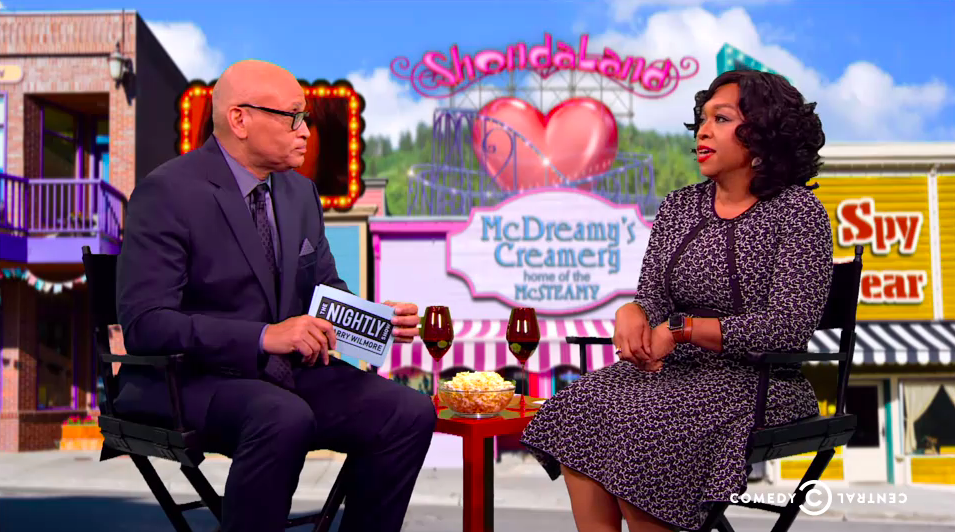
SHONDA RHIMES ON "THE YEAR OF YES!" AND F.O.D.


LARRY WIMORE:

“Have you ever killed off a character because you didn’t like the actor? And extra bonus points, who was it? Don’t even think about lying.”


SHONDA RHIMES:

“Yes, and I’m not naming names.”


I'll mention a name. On Scandal, the actor who plays the Harrison Wright character got into a couple of barroom brawls then finally hit his girlfriend or wife.

Harrison died, barely had a funeral, and had somewhere near zero flashbacks.


Some people were boohoo-ing over this character's death. Ummm...He's cute. Very.  And I was sad to see him go. But there's not enough cute in this world for me to give a pass to a man, especially a black man who is supposed to have our collective black female backs, who is hitting folk then finally hits a black woman. 


As a feminist, I'm kinda guessing that Shonda Rhimes feel the same way.

Shonda's Book "The Year Of Yes!" is out. She talks about it on Comedy Central, on Larry Wilmore's show. There's an interesting conversation about being black and being a pioneer in a certain industry, which she describes as being an F.O.D. (First Only Different)  She is an F.O.D. President Obama is an F.O.D. She describes the pressures and outcomes of being an F.O.D.

I already bought "The Year Of Yes!" It's in line to be read behind some black female history books. This sounds like a late December, have something new in my head for the beginning of the new year kinda of a book. But the interview makes me I think I shouldn't wait to read it. 


Here's some of the interview on her life and her book. Even in small doses, Shonda's kinda awesome. 


You can also see Video Here:

http://www.thewrap.com/shonda-rhimes-confesses-to-killing-off-a-character-because-she-didnt-like-the-actor-video/


Saturday, October 31, 2015

11 WAYS READING OCTAVIA BUTLER WILL CHANGE YOUR LIFE

Feeling Rebloggy

"A lot of people shy away from science fiction. A lot of readers are afraid of the genre, or assume that it is all aliens and dystopias. But after reading Kindred(which transports you back to a 19th-century plantation) or Fledgling (a vampire science fiction novel), you'll know that science fiction is much more than space stations and robots. Science fiction can be anything, take place anywhere, and include everyone. After reading Butler, you will know that there is no place sci-fi can't take you."


1. You'll Stop Making Excuses For Why You Don't Go After What You Want

2. You'll Learn The Term "Afrofuturism," And Understand Why It Matters


3. You'll Never Worry About Being A Woman In A Man's World Again...


11. You'll know black women can do anything. (yes, that's my addition)


Read the rest of the list
http://www.bustle.com/articles/73251-when-you-read-octavia-butler-be-prepared-for-these-10-things-to-happen